We & Goliath & The Story of Stuff Project Team Up to Launch the Virtual Rally to Reclaim Nestlé’s Troubled Waters!

What can you expect at Thursday’s Virtual Rally to Reclaim Nestlé’s Troubled Waters? How about hearing from grassroots leaders from across North America – featured speaker Representative Rashida Tlaib – musical performance by Tune-Yards – and a special celebrity guest. The event also features an interactive attendee photo booth that we designed to add a layer of togetherness.

Virtual Event Innovators Help Non-Profits Pivot Their Events Online with up to 7X Attendance and 3X Revenue

ASHEVILLE, NC – With Zoom fatigue kicking in, many find online event attendance dwindling, and online revenue hard to match. However, some innovative online event planners are helping nonprofits stay on track to meet and exceed their goals.

NARAL Pro-Choice America, a 2.5M member nonprofit, recently hosted a virtual event unlike any Zoom webinar they had done in the past. This online Activists’ Summit brought over 1,500 attendees together in an interactive space with multiple simultaneous trainings, networking sessions, expo booths, polls and other interactive features. Speakers included Senators Elizabeth Warren, Cory Booker, and Jeff Merkley. Having their first full-scale virtual conference being one that would closely match the in-person experience helped build attendee excitement and doubled the attendance rate of NARAL’s previous online events.

Attendees feedback highlights how some large events don’t always go smoothly: “I was SHOCKED at how well the technology worked for such a large audience. Truly, positively, amazed given that the first virtual Biden activity I attended a month or so ago was much more technologically compromised,” said Lisa from Tarpon Springs, FL.

However, the event’s “control center” was not in NARAL’s Washington, DC, headquarters, nor in the usual-suspect neighborhoods of Maryland and Virginia. It was in the unlikely environs of an Appalachian suburb in North Carolina, where partners Michelle Garrison and Daniel Moss, online event consultants at We & Goliath led a team of designers, developers, strategists, and videographers to pull off something that hadn’t been done before.

“While everyone is used to hosting a zoom meeting by now, putting together a full-scale conference online with a high production value is a whole other thing,” says Moss, their Co-Founder and Leader Strategist. “Not only are organizations confused about which event platforms and features they should use, but how to produce an online event that goes smoothly, looks great and is highly interactive.”

The founders of another training conference Organizing 2.0 were thrilled when they were able to get 7X their attendance in their first virtual conference, going from an average of 250 attendees in-person over 11 years, to 1,683 registrations online. The comprehensive and interactive online conference enabled Organizing 2.0 to maintain their same ticket prices as with their in-person event, offer many free tickets, and still more than triple their in-person revenue.

Like most events, fundraisers have gone virtual too. NARAL later worked with We & Goliath to merge two of their biggest fundraisers into one virtual event and was able to raise 1.3M in the campaign, including over \$80,000 during the 1-hr live experience.

A smaller nonprofit, Equal Rights Amendment Coalition, asked We & Goliath to produce a panel discussion and celebrity-infused fundraiser with speakers including Alyssa Milano, Patricia Arquette, and Ilyasah Shabazz. Along with the live event, was an immersive hub optimized for donor conversions and driving their key actions like signing a petition to ratify the ERA, and an interactive tool where voters can see where their candidates stand on the issues.

“Though we’ve done event marketing for many years, these were the first times we launched large virtual fundraisers and they were quite a success,” says Garrison. “The means to that end is powerful content, beautifully presented, that builds a sense of togetherness. Then, creating excitement and demand for that content.”

The We & Goliath brand, which was created last year as a merger of two small digital agencies, is a nod to author Malcolm Gladwell’s retelling of the David and Goliath battle of biblical fame… Gladwell says David wasn’t an underdog because he knew he’d win after training with his sling to protect his sheep for many years. “We all face Goliaths at some point, but we don’t all have the skills or tools to tackle them on our own,” says Moss. “Let us be your secret weapon.”

About We & Goliath

We & Goliath is a beautique virtual event consultancy helping mission-driven organizations to create virtual experiences that are remembered and enjoyed. Each of We & Goliath’s senior consultants has nearly 20 years of experience with event marketing and production, including virtual and in-person summits, conferences, festivals, workshops, tours, rallies, fundraisers, and retreats. Our goal is to create virtual experiences that spark conversations, inspire community, close deals, and accomplish huge missions.

A Get-Out-the-Vote Digital Powwow – Because voting while Native is Complex Yet Necessary!

We & Goliath was proud to help produce this play on the intertribal social dance powwows where Native people and powwow-goers visit casually while enjoying culture and building relationships … the Sko Vote Den Virtual Intertribal was designed to build political awareness and joy around getting out the vote in Indian Country.

 The Event featured 4 panel discussions, 4 musical guests, 2 comedian hosts, 2 indigenous senators and one-and-only Faith Spotted Eagle, the 1st Native American to win a U.S. presidential electoral vote

Article originally published on ndncollective.org

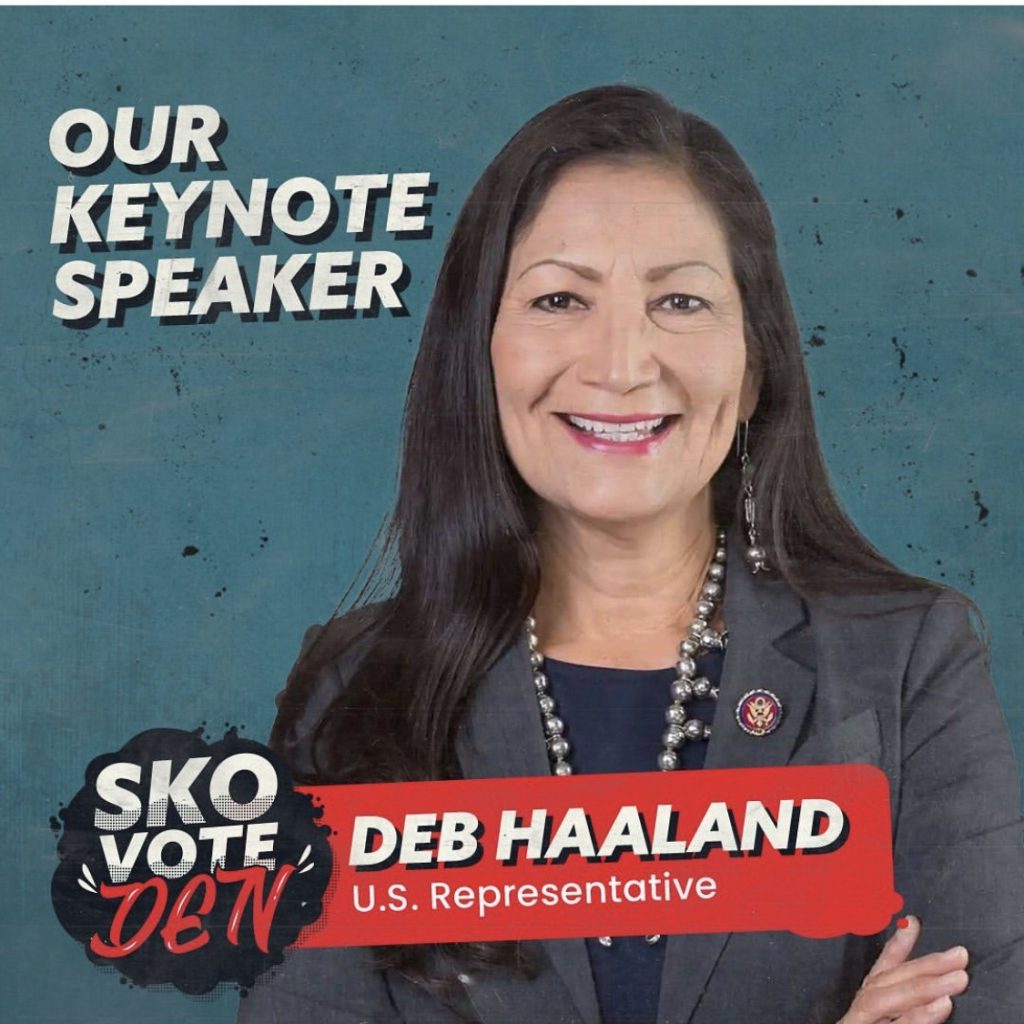
Last week, Representatives Sharice Davids and Deb Haaland joined NDN Collective and NativesOutdoors for Sko Vote Den Virtual Intertribal, an event aiming to engage Native voters ahead of election day. The elected officials joined Indigenous organizers, artists, and entertainers to discuss voting challenges, and to educate people about the complexities and importance of voting in Indian Country. You can watch the full, recorded livestream below. 

As Indigenous-led organizations we know that voting is a complex issue for Native people and communities. Therefore, we wanted to embrace and talk about the complexities, while inspiring and educating our people about the importance of voting in this historic election. 

A play on the intertribal social dance powwows where Native people and powwow goers visit casually while enjoying culture and building relationships, the Sko Vote Den Virtual Intertribal was designed to build political awareness and joy around getting out the vote in Indian Country. 

During the Sko Vote Den Virtual Intertribal, with the help from Emcee’s and moderators, we framed up conversations from an Indigenous lens, sharing political analysis about this year’s election, and also providing helpful resources on how and when to vote. 

“I recently learned that 11,000 new Native voters were recently registered across the country — this could not have been done without local work on the ground,” said Representative Deb Haaland. “I’m an organizer — for nearly two decades, I registered voters, knocked on doors, and made phone calls in Indian country all across New Mexico. It’s not easy work, but my experiences showed me that Indian country is the strongest when we work together.”

We learned from organizers about the barriers that exist in Indian countries when it comes to voting and how we overcome voter suppression by working together and building unity and strong grassroots groups and coalitions.

“Voting helps impact who is at the decision making table ,” said Representative Sharice Davids. “My job now, as an elected, is to listen to people. For too long, we didn’t have people in office who were listening to folks. Native people don’t need someone else to be our voice — we need people who are in decision making positions to be listening.” 

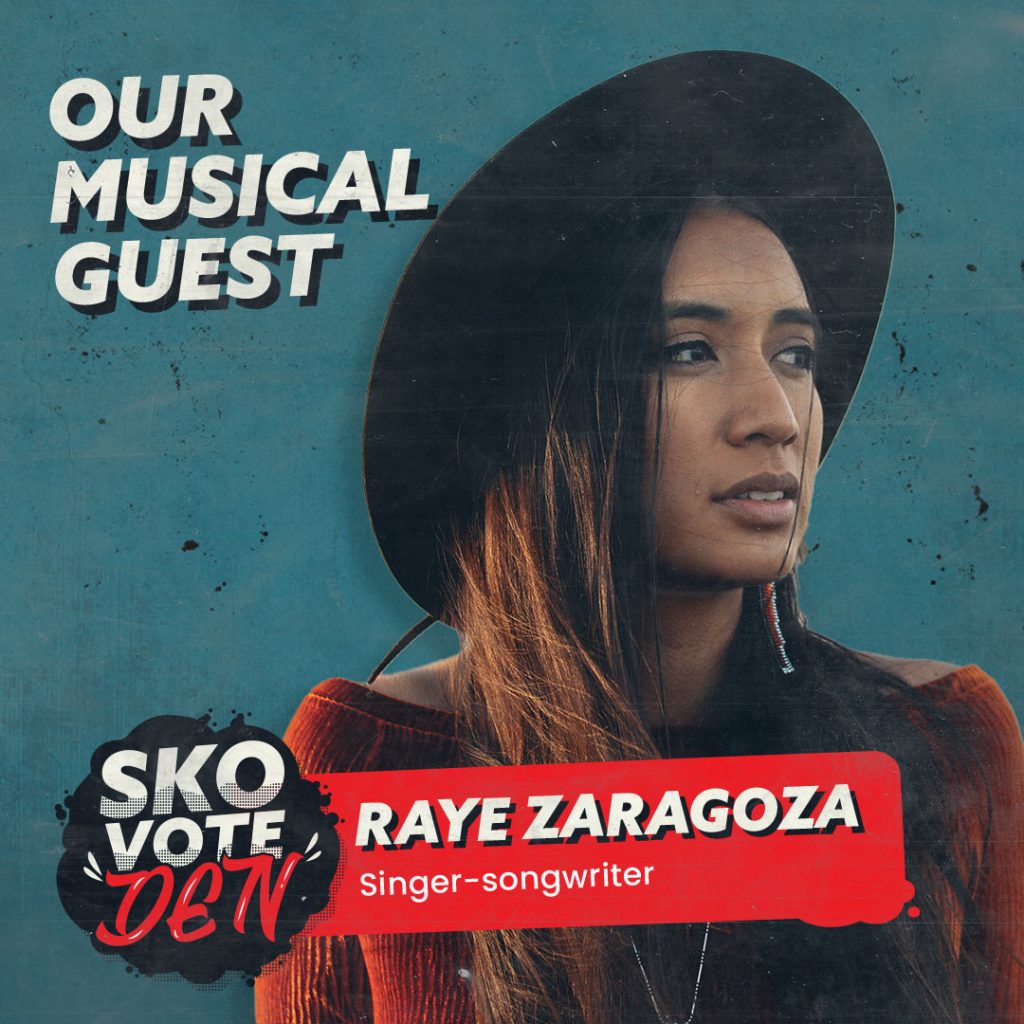
Musical guests and entertainment included Raye Zaragoza, Mic Jordan, and Holiday Simmons.

What the SKO-VOTE-DEN Virtual Intertribal signaled was that Native People from the U.S./Mexico border to the Arctic, are ready and more than prepared to work with and build with elected officials to foster justice and equity in our communities, towns, states, and country and we are determined to put decision makers into office who will listen and be accountable to our people and who will honor tribal sovereignty . What this event also signaled is that while we work diligently to get out the vote in Indian Country, we are also committed to other forms of building Indigenous power, like grassroots organizing, direct action, and resourcing Indigenous frontlines communities and movements. Watch a 10-min highlight video of the event below.

Here is a complete line-up of panels, entertainment and guests who appeared on the SKO-VOTE-DEN Virtual Intertribal:

In order of Appearance:

Host Drum: Mile High Singers, Denver, CO

Emcees: Tonia Jo Hall and Tatanka Means

Keynote Speaker: Rep. Deb Haaland

Keynote Speaker Convo: Nick Tilsen, NDN Collective President and CEO and Rep. Sharice Davids

Panel 1, Building Collective Power: Sarah Manning, Amber Starks, Layel Camargo, Nicole Yanes

Entertainment: Raye Zaragoza, Singer

Keynote: Faith Spotted Eagle, Braveheart Society

Panel 2, Empowering the Youth Vote: Xiuhtezcatl Martinez, Joey Montoya, Quannah Chasinghorse-Potts, Jade Begay

Entertainment: Holiday Simmons, Spoken Word Artist

Keynote: Natalie Landreth, Native American Rights Fund

Panel 3, Climate Justice: Shandiin Cedar, Bernadette Demientieff, Niria Alicia, Wahleah Johns

Entertainment: Mic Jordan, Musician and Hip Hop Artist

Corporate Video Production

Our Freedom, Our Fight: We & Goliath Helps NARAL Pro-Choice America Host First-Ever Activists’ Summit

Sens. Cory Booker, Elizabeth Warren, and Jeff Merkley along with U.S. Senate Candidate Jaime Harrison and Progressive Movement Leaders to Join Hundreds of Reproductive Freedom Voters for Virtual Summit

WASHINGTON, DC — NARAL Pro-Choice America is hosting its first-ever Activists’ Summit, “Our Freedom, Our Fight,” this weekend (Saturday, August 8 and Sunday, August 9) to engage, train and mobilize hundreds of NARAL members as NARAL ramps up its voter contact efforts in the final 80+ days before the election. NARAL President Ilyse Hogue and other NARAL leaders will be joined by Senators Cory Booker, Elizabeth Warren, and Jeff Merkley, along with U.S. Senate candidate Jaime Harrison and leaders and experts in the progressive movement.

The summit aims to educate, engage, and empower reproductive freedom activists and supporters from every part of the country, giving them the tools they need to fight back against attacks on abortion access and elect champions for reproductive freedom. The summit will feature workshops on core campaign tactics like hosting voter contact parties, phonebanking, and combating political disinformation.

The Activists’ Summit is the latest effort in NARAL’s largest-ever electoral program that plans to invest $34.7 million toward integrated organizing, communications, digital, and political programs designed to target races up and down the ballot across several key states in this consequential election cycle. NARAL has shifted its organizing entirely to a virtual format in the face of the still-raging COVID-19 pandemic and over the past five months, NARAL organizers and volunteers have hosted voter contact parties, phone banks, happy hours, and fireside chats with NARAL-endorsed candidates for elected office.

We & Goliath is proud to support NARAL with virtual event production and management for their first-ever virtual conference.

####

NARAL Pro-Choice America and its network of state affiliates and chapters are dedicated to protecting and expanding reproductive freedom for all. For more than 50 years, NARAL has worked to guarantee that every woman has the right to make personal decisions regarding the full range of reproductive choices, including preventing unintended pregnancy, bearing healthy children, and choosing legal abortion. Since 1969, NARAL has made history, grown to over 2.5 million members, and met the moments that have defined this fight with action, power, and freedom. In recognition of its work defending our constitutional right to choose, Fortune Magazine described NARAL as “one of the top 10 advocacy groups in America.” 

EVENT MARKETERS: Why People Aren’t Signing Up For Your Event & What to Do About It (Without Spending a Dime)

Are your event registrations lagging behind your expectations?

Here are some event marketing tips to quickly improve your sign up rate … without spending a dime.

Before jumping into spending more on promotion, these strategies will help you figure out why people aren’t signing up and improve your conversion rate, so every dollar you do spend goes much further.

Build Trust and Enthusiasm with Video Testimonials

Video testimonials communicate so much more than written ones by carrying emotion, enthusiasm, through tone and body language, etc. They truly are the best way to build trust and credibility.

How to collect video testimonials

  1. Get videos from your past event participants – Ask people from previous events if they’d be willing to record a video testimonial. Ideally, get these from both performers/presenters and participants.
    • videoask.com by Typeform makes this very easy and is free for up to 20 responses / mo
  1. Record video testimonials in-person during your events. This is not only the easiest time to ask people, but you’ll get responses that reflect the energy and enthusiasm of your attendees.

Share your video testimonials

  1. Embed the best of them in your site. Ideally, edited down into a single video with short clips from many people.
  2. Email your list with a link to watch them.
    • Bonus Tip: include an animated image in the email with a clip of the videos dramatically increases email click-through-rates
  1. Post them on your social media profiles 

The Art of Strategic Teasing (That Doesn't Feel Salesy)

We’ve all seen those cringe-worthy “DON’T MISS OUT!!” banners.

But when the Portland Poetry Slam wanted to double early registrations without paid ads, they accidentally stumbled into what I call “FOMO gardening” – cultivating anticipation through deliberate, authentic withholding that connects to core attendee motivations.

The key lies in treating your event like a serialized Netflix series rather than a product launch.

People don’t resist stories – they resist sales pitches.

This shift transforms casual browsers into invested participants slowly, like that friend who “hates spoilers” but obsessively theorizes about plot twists.

Three Underused Teasing Channels (That Actually Work)

1. Email Subject Line Roulette

Rotate 3-4 curiosity-piquing variants for the same announcement:

  • “The 11:15am Slot That Nearly Caused a Committee Meltdown” (plays on loss aversion)
  • “Why We’re Limiting ____ to 50 Participants” (artificial scarcity)
  • “Surprise Guest Requirements Leaked” (then reveal mundane details like dress code)

This isn’t clickbait – it’s strategic information parcelling.

The Oregon Book Festival found open rates jumped 37% when using rotating subject lines that hinted at internal drama rather than direct sales messages.

2. Partial Speaker Reveals

Instead of full bios:

  • Share anonymous quotes from their presentations (“I once saw a CEO cry during this talk”)
  • Post extreme close-ups of presentation slides (showing only compelling data points)
  • “Accidentally” leak 8-second audio clips in Instagram Stories

The trick? Leave gaps the mind compulsively tries to fill. A tech conference organizer reported 22% more speaker session sign-ups when using blurred slide images vs full disclosures.

3. RSVP-Locked Content

Gate genuinely useful (but low-effort) resources:

  • Speaker-curated resource lists (“The 3 Books That Changed My Career”)
  • Interactive planning templates with hidden bonus sections
  • “Cheat sheets” for maximizing event value

But here’s the twist – make the locked content unexpectedly valuable. A nonprofit gala offered registrants first dibs on volunteer opportunities with presenters, creating a secondary FOMO layer.

The Psychology Hack Most Miss

Strategic teasing works because it activates information gap theory – our brains hate unresolved patterns.

The Portland team found registrations spiked when they posted a venue map with 3 “classified” rooms blurred out.

Attendees weren’t just buying tickets; they were buying the right to solve the mystery.

Implementation Notes:

  • Teases must contain genuine substance – empty hype dies faster than a Snapchat story
  • Align mystery elements with your audience’s professional insecurities (e.g. “The CFO Hack We Can’t Put in Writing”)
  • Let 20% of teasers remain unresolved post-event to fuel future interest (“Remember the blue door? 2025’s secret…”)

This approach creates natural bridges to later sections:

  1. Testimonials gain context (“Now you understand why the blue door mattered”)
  2. Objections address teased elements organically
  3. UGC prompts become mystery-solving missions

The magic happens when you stop announcing and start unfolding – transforming marketing from transactional checklist to communal discovery journey.

Understand & Overcome Objections

Most websites average a 2-3% conversion rate. So if 2 in 100 people visiting your event site who get a ticket, you’ve got an average conversion rate.

Increase your conversion rate from 2 to 3 percent and you’ll be getting 50% more revenue from your existing website traffic!

If your page is better-than-average, there’s always room for improvement. If you’re doing worse than that, clearly, there must be some significant reasons people are not registering.

Your first job is to discover what exactly are the reasons why people are not signing up.

These could include questions and concerns about event times/costs, who the event is for, how it’s better than other options they’re considering, and what they’ll get out of it.

Here are some proven methods and what to do with those insights:

UNDERSTAND: 3 Ways to Discover the Top Objections Blocking Your Event's Ticket Sales

  1. Call and talk to a few people you know are interested but haven’t signed up yet. Ask about what makes them interested to join and what is holding them back. Record the calls if possible, or take detailed notes in their own words.
  2. Add a survey on the site asking the above questions
  3. Add a live chat widget – this allows you to understand and handle objections in real-time!

OVERCOME: Update the event page and marketing language with the answers needed to respond to people's hesitations, concerns, and doubts.

  1. If people have a lot of questions – consider adding a FAQ section (this could be embedded in the Live Chat widget or a section of your webpage)
    • I recommend www.Tawk.to – free, full-featured live chat or Facebook Messenger – can also be added free. The main benefit is the chat continues after people leave the site!
  1. If price is a major concern – consider lowering your price or offering incentives
    • Consider group discounts, non-profit discounts, photo or video contests, early-bird discounts, and giving a commission to referral partners.
  1. If people aren’t getting excited – consider adding an overview/promo video at the top of the page where you explain what the event is all about, who it’s for, what they’ll get out of it, how it’s unique and better than other options people may compare it to.
  2. If it’s none of the above, and people still aren’t getting excited – ask them “what would make this event more exciting to you”? Be humble and open to feedback. Maybe people would prefer a different event format, possibly something more interactive for example. Maybe they want a shorter event, or more detailed and expert-level. Unless you ask, they’ll probably never tell you.Reasons to consider an event promo video include:
    • Many people prefer watching a video to reading (and just scan without really reading the details)
    • If your event is unique or complex, a video gives you an important chance to clarify, explain and show your enthusiasm
    • You could splice in highlights of video testimonials in the middle

Find & Fix Usability Issues

Identify usability issues

confusing navigation and form fields. Also, look for which step in your event signup process has people dropping off, and work on improving that page. 

  • HOW TO: Install Hotjar’s free heatmap, funnel, and user recording software.

Ensure the site is mobile-friendly

Most sites are mobile-responsive, but they also need to easy to read and navigate.

Speed up your site

Every second of extra load time and hurt conversion rates

  • HOW TO: There are many free and paid WordPress plugins that can help here including Smush-it or Optimole for image compression, and WP Rocket or WP Optimize for advanced modifications like javascript minification. Run a test before and after changes at gtmetrics.com to measure the impact

Get your SSL on lock

Setup a security certificate to add the lock symbol in the browser. Even if your checkout doesn’t take place on your site itself – as is the case if you have people pay on PayPal or Eventbrite, your website visitors won’t know this in advance, and may wrongly assume you’ll be asking for a credit card on your insecure site.

  • HOW TO: Most hosting companies provide free SSL now. You can easily integrate it with the WordPress plugin Really Simple SSL. It sometimes does the trick automatically. If not, it’s probably because you have hard-coded links to http:// version of your pages (instead of using “relative URLs” that start with /about-us). In this case, you may need to run a “find and replace” function to change all links from http to https.

Leverage Your Network for Organic Reach

When it comes to event marketing, one of the most underutilized yet powerful strategies is building partnerships within your community.

Collaborating with local businesses, influencers, and organizations can extend your reach exponentially without adding to your budget.

This approach not only boosts visibility but also fosters a sense of community around your event.

Why Community Partnerships Matter

Think about it: every business, influencer, or organization has its own audience.

By partnering with them, you’re essentially borrowing their trust and credibility to introduce your event to a new group of people.

This strategy is particularly effective because recommendations from trusted sources often carry more weight than traditional advertising.

Moreover, partnerships create a win-win situation.

While you gain exposure, your collaborators benefit from the association with your event, whether through increased visibility, co-branding opportunities, or direct engagement with their audience.

How to Build Meaningful Partnerships

Building effective partnerships requires intentionality and a clear understanding of mutual benefits.

Here’s how you can get started:

  • Identify the Right Partners: Look for businesses or organizations that align with your event’s theme or target audience. For example, if you’re hosting a sustainability workshop, local eco-friendly stores or environmental nonprofits would be ideal partners.
  • Offer Value in Return: Partnerships thrive on reciprocity. Offer something valuable in return for their support, such as free tickets to the event, opportunities to showcase their products or services, or co-marketing efforts that highlight their brand.
  • Collaborate Creatively: Go beyond simple promotions. Co-create content like blog posts or videos, host joint giveaways, or even plan a pre-event activity together. For instance, a local coffee shop could host a casual meet-and-greet for attendees before the main event.

Examples of Collaborative Marketing Ideas

To make this strategy actionable, here are some specific ways to collaborate:

  • Joint Giveaways: Partner with a local business to offer a giveaway where participants must sign up for your event to enter.
  • Cross-Promotions: Ask partners to display flyers at their locations while you promote their offerings at your event.
  • Pre-Event Content: Work with an influencer or partner organization to host a live Q&A session about the event on social media platforms.

Why This Approach Works

Community partnerships tap into existing networks and build excitement organically.

They also demonstrate that your event is supported by trusted local entities, which can help alleviate skepticism from potential attendees.

Plus, these collaborations often lead to long-term relationships that can benefit future events.

Finally, Drive More Traffic and Stay Top of Mind 

Once you have the above issues addressed, you’re ready to drive more traffic with confidence.

The quickest and most scalable way is to pay for ads on Facebook or other platforms to drive more traffic to your event. But these free methods can go a long way

Remember – everyone is busy and distracted.

You can’t just send an email and make one Facebook post and assume all your people heard about your event.

Basically… you need to be a little annoying.

Email your list, not just once, but a series.

Don’t just directly sell in these emails though … provide value with tips, entertainment, and build up excitement with announcements of new performers/speakers, etc.

Direct message people on Facebook

Facebook messenger, along with text messages, get the best response rates of any marketing channel. And if you use these for real personalized invites, you’ll be surprised at how positive the response is.

Send bulk, personalized text messages

If you’ve got a list of phone numbers from past efforts, send out a single text with an event announcement.

If you’ve collected phone numbers from people expressing interest in this particular event, you can send out a series of texts that parallel your emails, with short reminders.

Many marketing automation programs integrate with CRMs (customer relationship management software) and will let you send bulk, personalized messages not only with their names, but mentioning events they’ve attended in the past, or referencing other “tags” in your CRM, such as “donor”.

Add a Facebook retargeting pixel

Here’s a common oversight we see even seasoned marketers make: skipping the Facebook retargeting pixel setup because “we’re not running ads right now.”

Let’s fix that thinking permanently.

Install that pixel before your event page goes live—even if paid campaigns aren’t part of your current strategy.

Why? Because every visitor becomes part of a warm audience you can re-engage later.

Think of it as planting seeds for next season’s harvest.

Once active, this tool builds a list of people who’ve already demonstrated interest by visiting your event details.

These aren’t cold leads; they’re individuals who’ve raised their hand saying, “Tell me more.”

Later, when promoting a similar gathering, you’ll have direct access to this group.

Retargeting ads often deliver better ROI than broad campaigns.

People who’ve previously interacted with your content convert at higher rates because they recognize your brand.

You’re not shouting into a crowded room—you’re having a follow-up conversation with someone who already glanced at your brochure.

The magic happens in the follow-through.

Custom audiences built from pixel data let you craft messages specific to how people engaged.

Did they view pricing but bail? Hit them with a limited-time discount.

Did they watch your promo video? Serve the full webinar link.

Yes, the setup takes 15 minutes. Yes, it feels like a tiny technical step. But here’s what changes: Suddenly you’re not just hoping interested folks remember your next event—you’re putting it directly in their feed.

Why let that window close? Event promotion isn’t just about filling seats this time—it’s about nurturing relationships that fill them every time. The pixel becomes your silent ally, quietly expanding your reach long after the initial RSVP deadline passes.

(Pro tip: Layer this with LinkedIn retargeting for B2B events. Suddenly you’re covering both personal and professional browsing habits.)

Post regularly on Facebook, in 5 different ways

Don’t think that just creating a Facebook event and sending a clicking the “invite” button will bring people out in droves. You need to be active with posting to get seen, build excitement, and give people content to share.

Here are the five types of posts we recommend to promote your event:

  1. Post on your business Page – as you probably know, these posts sadly don’t get shown much anymore unless you pay to boost them. However, you can take the same content from here and share it in the following four places to maximize your reach.
  2. Post on your Event page – everyone who’s clicked Interested or Going will get a notification when you add a post to your event page
  3. Post on your personal wall – while Facebook has greatly diminished your Page’s organic reach, your personal posts still get seen by a lot of your friends
  4. Post in your Facebook and Instagram Stories – these posts show up above the news feed and if people regularly watch your Stories, your posts will show up first in their list. Stories are great for less polished
  5. Post in relevant Facebook Groups – often overlooked, there are Facebook Groups for every city and interest group you could imagine.

Get listed on event calendars

Post your event in online event calendars and those in local newspapers.

Don’t forget good ol’ postcards and flyers.

Gotprint.com has some of the best prices and options for recycled paper. Note: glossy paper can not be recycled.

We can help with postcard design, and mailing via an uploaded list or even collect addresses from people who visit your site.

GET A FREE VIRTUAL EVENT STRATEGY SESSION

Tell us about your ideas and goals for an online summit or conference … we’ll answer any burning questions about your event planning and strategy and see if we’re a good fit to work together.

ABOUT WE & GOLIATH

You do good work in the world. We help it reach more people. With 20+ years of battle-tested digital strategies, let us be your secret weapon.

Our lead strategists, Daniel and Michelle, each have decades of experience producing and marketing hundreds of online and in-person events for grassroots organizations. 

The Ultimate Guide to Newsjacking

What is Newsjacking?

Newsjacking, as bestselling author David Meerman Scott defines it, is about injecting your ideas into breaking news stories.

Essentially, you give a breaking news story (or trending twitter hashtag) a personal twist with a very quickly published blog or social media post. 

Benefits of Newsjacking

Journalists look for experts to quote in their second paragraphs, and if you’re one of the first to cover a situation, they may find your post and reference you. 

From the Author

In his digital-only book —  Newsjacking: How to Inject your Ideas into a Breaking News Story and Generate Tons of Media Coverage — Scott lays out a three-step process for effective newsjacking.

This infographic covers a lot of ground. Let’s break it down a bit with some detailed tips: 

Step-By-Step Guide to Newsjacking

Step 1: Set Up Alerts — A big part of successful newsjacking is being first to the action. You want to keep a close watch on trends in your industry and big news in general.

  • I am a big fan of www.talkwalker.com/alerts‎ – they’re free and much more thorough than Google Alerts.
  • Also, I highly recommend the contentgems app inside of hootsuite – which pulls trends from 200,000+ sources and puts it right into Hootsuite where you can easily sent it out to all your social channels.
  • Follow all your favorite blogs in one place with feedly, my favorite RSS reader

Step 2: Check Keyword Search Volume — incorporate the most popular related phrase in your title.

  • The Google Keyword Planner will give you estimated month search volume for any phrase and give you recommendations for related phrases you might not have thought of. Sort by

Step 3: Read About Your Topic — read the original news story and what else has been written.

Step 4: Write Quickly, but Accurately — don’t obsess as timeliness is key

Step 5: Differentiate Yourself — Always inject your own angle, and/or be more thorough, more clear, offer how-to’s, or provide more meaningful examples. (tip: the longer you wait, the more detailed and unique you need to be for this to be successful)

Step 6: Get the Word Out — don’t just share it on your social media pages, do all you can to hype it up big time

  • blog about it
  • re-tweet and re-facebook it using trending hashtags
  • share it on related facebook pages and @mention relevant twitter profiles
  • email it to your lists
  • foster long-term relationships with partners and journalists

Step 7: Watch the Reactions — Look out for negative reactions. Many-a-newsjack goes wrong and offends people. If this happens, apologize and take down your blog or social post. 

Read more – The above “How to Newsjack” steps are summarized from HubSpot’s Complete Guide to Newsjacking

Successful Newsjacking Examples

Newsjack Live Events on Social Media

Oreo Cookies — During the blackout at the Superbowl, Oreos send out this genius tweet:

https://twitter.com/Oreo/status/298246571718483968/photo/1

The Result: Their creativity was rewarded with 15,000 tweets in 24hrs. With the game on pause for so long, many people went online to discuss and Oreo took advantage!

Newsjacking Social Movements

While many brands are afraid to take a stand on political issues for fear of polarizing their audience, Banana Republic “came out” for marriage equality.

The Result: 5,000 likes and 800 shares

Newsjacking Your Competitors

Eloqua — When one of their biggest competitors was purchased by Oracle, Eloqua’s CEO Joe Payne wrote a detailed blog post. The next day, when journalists went to cover the issue, all they found was a very generic press release by Oracle and Payne’s excellent write-up. Payne was quoted in numerous articles on the acquisition including BusinessWeek and PC World. (Read more about this standout move here.)

The Result: $1M in new business for Eloqua within a week!

Mediocre Examples

While great in theory, this newsjacking formula doesn’t always generate huge results. Take for example, Pardot’s post on what B2B marketers can learn from instagram’s billion dollar payday. A well written post, the day after a big news event, posted with a unique spin.

The Result: 5 sites linked to it and 0 shares on social media. Why wasn’t it more successful? Basically, they followed all the steps and didn’t do anything wrong, but it’s missing the humor, extreme-usefulness or controversy that generally makes this technique rock.

If you try to latch on to a big news story without adding any value or real creativity, you might end up on the wall of shame at the CorCondescending Corporate Brand Page.

Newsjacking Fails

Cairo protests

Kenneth Cole’s tweet about their Spring Collection referencing the Arab Spring is infamous. Had nothing to do with fashion and was very insensitive.

Kenneth apparently ascribes to the old adage “Any press is good press”, because just recently tweeted “”Boots on the ground” or not, let’s not forget about sandals, pumps and loafers. #Footwear” in response to the CIAs statement about Syria. This has spurred someone to create a parody Twitter account, churning out offensive witty newsjacks on their behalf. 

Hurricane Sandy

Hubspot wrote a post about how to newsjack Hurrina Sandy and really rubbed a lot of people the wrong way.

However, they did the right thing and apologized, changing the title of their post to “Is Newsjacking Hurricane Sandy Right or Wrong?”, asked for feedback and responded the wave of responses without censoring negative comments. 

Spamming with Irrelevant Hashtags

Including hashtags that have nothing to do with your services or your post just makes you look cheap and spammy. Don’t be that brand. 

George Zimmerman Trial 

Is Newsjacking Worthwhile?

Unmetric analyzed data from 10 infamous twitter newsjacks (5 positive and 5 negative). Their results show an average 0.7% increase in followers, ranging anywhere from 100-2000 new followers.